
Blog · Industrial
How Does a Centrifuge Work for Industrial Waste Separation?
By Stage 3 Separation ·
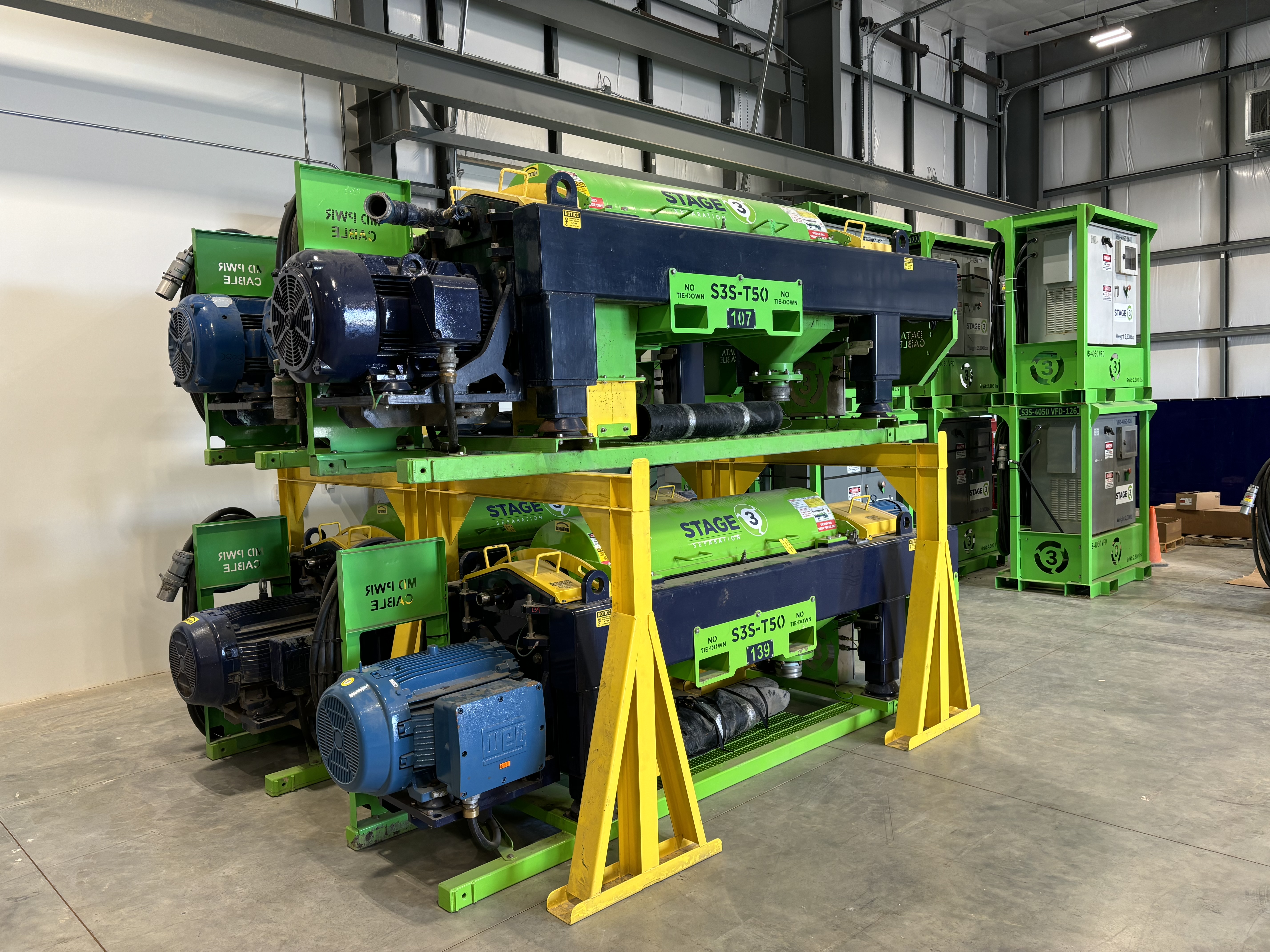
The Physics of Centrifugal Separation
A centrifuge separates materials of different densities using rotation instead of gravity. Waste material enters through a feed pipe at the center of a rotating bowl. The bowl spins fast, sometimes exceeding 3,000 RPM, generating centrifugal force up to roughly 3,000 times the pull of gravity.
At that force, density differences that would take hours to sort out by gravity alone happen in seconds. Heavier solid particles move outward to the bowl wall. Lighter liquid stays closer to the center. A scroll conveyor inside the bowl continuously pushes the accumulated solids toward one end of the machine, where they discharge as a de-watered cake. The liquid moves toward the center and exits over adjustable overflow weirs at the other end.
Why Rotation Beats Settling
Traditional settling tanks rely on gravity, which separates materials slowly and only works well when the density difference between solid and liquid is large. Fine particles and materials close in density to the surrounding liquid barely settle at all under gravity, and a tank designed for that kind of separation has to be large enough to give the material time to settle out.
A centrifuge does the same job with far less time and far less footprint, because the force is not fixed at 1G. Turning up bowl speed increases the separating force applied to the material, which lets a centrifuge process the same volume in a fraction of the space and time a settling tank would need, and lets it work on separations a settling tank cannot handle at all, including fine solids and multi-phase mixtures of oil, water and solids in a single pass.
Tuning the Machine to the Waste Stream
Not every waste stream behaves the same way. Metalworking fluid, drilling mud and process wastewater differ in particle size, density and viscosity, and a centrifuge set up for one will not necessarily perform well on another without adjustment.
Variable frequency drive (VFD) technology lets an operator change bowl speed and scroll differential speed while the machine is running, rather than fixing them at build time. That means the same machine can be tuned to handle a lightweight metalworking fluid in one job and a heavier drilling mud in the next, adjusting the separating force and residence time to match what is actually coming through the feed pipe.
Where the Technology Applies
Manufacturing plants use centrifuges to pull contaminants out of metalworking and coolant fluids, so the base fluid can be reused instead of hauled off and replaced whole.
Construction and drilling operations use mobile centrifuge units to process drilling mud onsite, recovering water and bentonite for reuse and leaving a solid that meets landfill acceptance requirements, including the paint filter test.
Chemical processing and oilfield operations use three-phase centrifuges to separate oil, water and solids from a single feed stream in one pass, which matters where the three phases need to be handled and disposed of differently.
What Keeps a Centrifuge Running Well
A centrifuge is a mechanical system spinning at high speed under continuous load, and it needs to be monitored and maintained accordingly. Vibration, bearing wear and imbalance are the failure modes that matter most, and catching them early is a matter of tracking performance over time rather than waiting for a shutdown.
Stage 3 Separation monitors its fleet remotely from its Houston facility, watching for signs of declining separation performance or mechanical wear so equipment can be serviced before it fails on a job site. Chemical dosing also needs adjustment as the waste stream changes through a project, since the coagulants and flocculants that help particles clump together only work at the right concentration for the material actually being fed into the machine.
What This Means for a Waste Management Decision
Centrifuge separation trades tank footprint and settling time for mechanical force and equipment cost. For waste streams where fine particles will not settle out on their own, where space onsite is limited, or where recovered fluid or water has enough value to justify recovering it, that trade works in the operator's favor. That decision is worth revisiting whenever the waste stream itself changes, since a machine sized and tuned for one job may not be the right fit for the next.
It is a piece of equipment, not a substitute for managing the waste stream correctly. Getting good results still depends on matching bowl speed, chemical dosing and feed rate to what is actually coming through the machine, and on keeping the equipment maintained under the mechanical stress of continuous high-speed operation.